
Enrichment strategy
Getting the output you expect is mostly a matter of matching the level of context you provide to the products you’re sending. This page is about making that call deliberately, before you spend a run finding out.
The two levers
Everything you can tune comes down to two things.
Brand voice controls how it’s said. Register, vocabulary, claims you make and claims you never make. This is the lever that decides whether the output sounds like you.
Raw data controls what there is to say. Enrichment writes from your source data and won’t exceed it, so the substance available to the generator is entirely a function of what you send it.
Neither lever works alone. Rich source data with a generic brand voice gives you accurate copy that could belong to any retailer. A sharp brand voice over thin source data gives you copy that sounds right and says nothing. When output disappoints, the useful first question is which of the two is actually short — and they call for completely different fixes, one in your config and one in your catalog.
The lever people miss: level of context
There’s a third dial, and it’s the one that most often explains a disappointing run: how tightly scoped the context is, relative to how varied the products are.
Remember what happens to your inputs. An agent reads your brand voice, keywords, and additional context, and writes rules at the field level — and those rules apply to every product in the batch. Context isn’t applied selectively to the products it happens to fit. So the specificity of your context and the variety of your assortment have to agree.
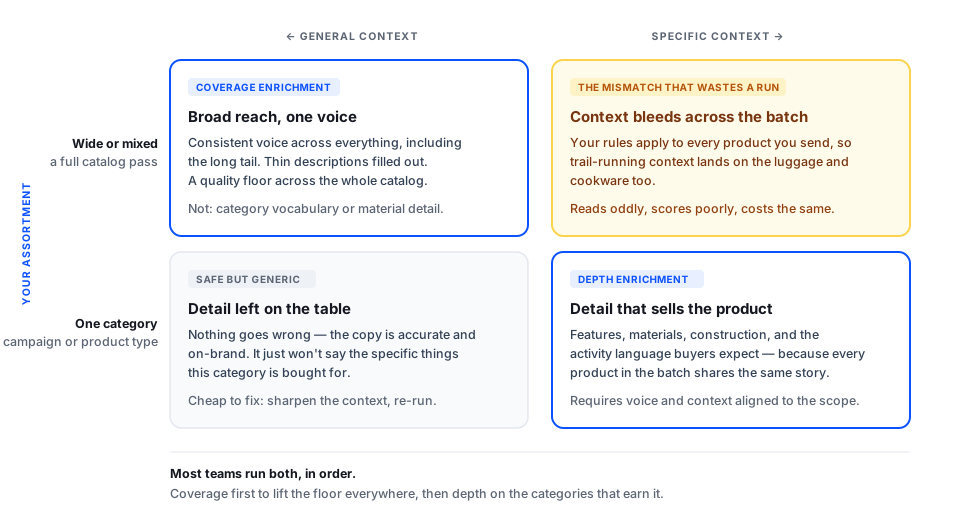
That gives you two working modes: coverage enrichments and depth enrichments. Neither is the better one — they buy different things.
Coverage enrichments
Broad assortment, general voice.
Use one when your assortment is wide, mixed, or unpredictable — a full catalog pass, a long tail of low-attention products, or any batch you can’t characterize in a sentence.
Here you supply a general brand voice and keep additional context minimal. The run applies a consistent voice across everything and expands thin product data into complete, usable content. You’re buying reach and consistency.
What you get:
- One recognizable voice across the entire catalog, including the products nobody has looked at in two years.
- Sparse descriptions filled out into complete ones.
- A quality floor everywhere, rather than excellence in a few places.
What you don’t get: category-specific vocabulary, or real detail on materials, construction, and use cases. The copy will be good and general, because general is what you asked for.
Depth enrichments
Single category, campaign, or product type, with voice and context aligned to it.
Use one when a specific set of products deserves specific treatment — a category you’re putting media behind, a seasonal campaign, a hero product line, a product type where the details are the reason people buy.
Here the output speaks to product features, activity and use-case language, materials, and construction with real detail. That’s the payoff. But it only works if you set it up properly, and the requirement is strict:
Scope the assortment and the context to the same thing. The products in the batch should be a single product category, campaign, or product type — and your brand voice and additional context should be aligned to that same scope.
That means:
- Narrow the batch. One category, one campaign, one product type. Not “outdoor” — running footwear.
- Align the additional context to it. Single-line instructions about what matters for these products: the activities they’re used for, the materials that distinguish them, the technical vocabulary buyers expect.
- Align the brand voice if it varies by line. If your performance line speaks differently from your lifestyle line, say so in the voice you supply for this batch.
- Check the source data first. This is where thin data shows most — you can’t write about a shoe’s outsole compound if the record doesn’t mention it.
Depth-enrichment context on a coverage-enrichment batch is the failure mode to avoid. Additional context about trail-running conditions gets written into field-level rules that then apply to the luggage and cookware in the same batch. The result reads oddly and scores poorly, and it costs you the same allotment as a run that would have worked. If you can’t describe the batch in one sentence, don’t give it one-sentence-specific context.
The opposite mismatch is cheaper but still wasteful: general context on a tightly scoped batch simply leaves the detail on the table.
Choosing between them
A sequence that works
Most teams shouldn’t pick one. They should run both, in order.
- Start with coverage. One pass over the catalog with a general voice, to lift the floor everywhere and give you a baseline to measure against.
- Find what earns depth. Your highest-spend categories, your best sellers, the products in the next campaign. A depth enrichment costs the same per item as a coverage enrichment, so spend it where it returns.
- Run those for depth, one scope at a time. A tightly scoped batch with aligned context, run and reviewed on its own.
- Keep the configs. A depth config that worked for one category becomes the starting point for the next campaign in that category.
Because usage counts every item you send, a depth enrichment over a few hundred products is inexpensive next to the coverage enrichment that covered your whole catalog — which is what makes this sequence practical rather than indulgent.
Where to go next
- Write the voice: Teaching enrichment your brand voice
- Write the context lines: Inputs and what happens to them
- Understand how inputs become rules: Generation configs
- Fix the other lever: What makes good source data